Included cover depends on the route you pick, not on the parcel
Whether a parcel has any free cover at all is decided by one choice: the shipping route. Hipobuy marks it in its estimator data, but the page shows both kinds of route with the same tag.
The same orange tag on every route
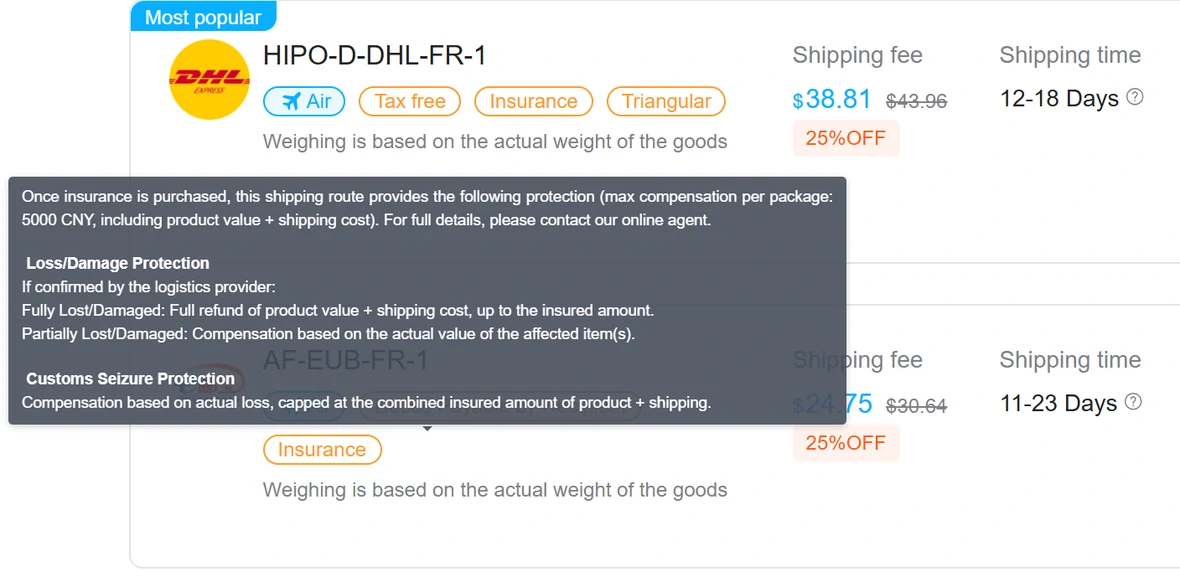
On the estimator's result cards, each route carries a line of tags. Routes that include free cover show "Insurance". Routes that only offer paid cover show "Insurance" too. The difference is invisible until you hover: on a paid-only route a dark box opens that begins "Once insurance is purchased, this shipping route provides the following protection". On a route with free cover, nothing opens.
We tested this on 16 October 2026 by hovering every tag on the French results for a one-kilo parcel and matching each card to the estimator data. All 56 cards behaved as the data predicted.
Ten destinations, 180 routes, 47 with free cover
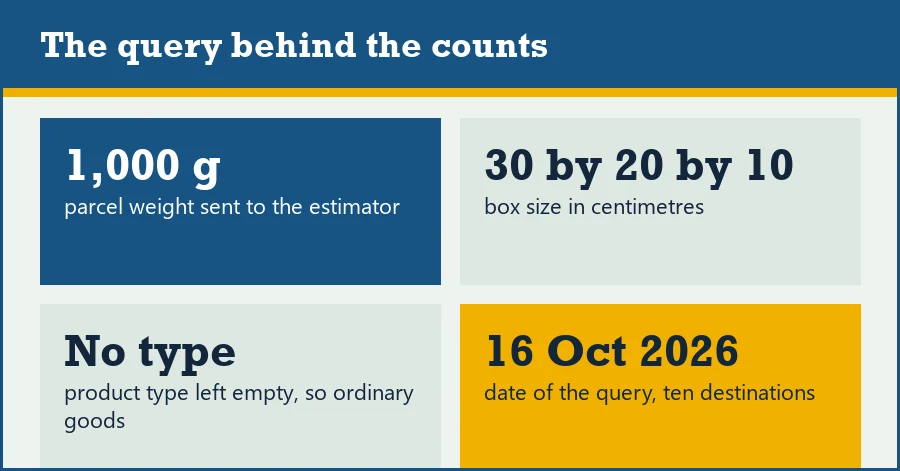
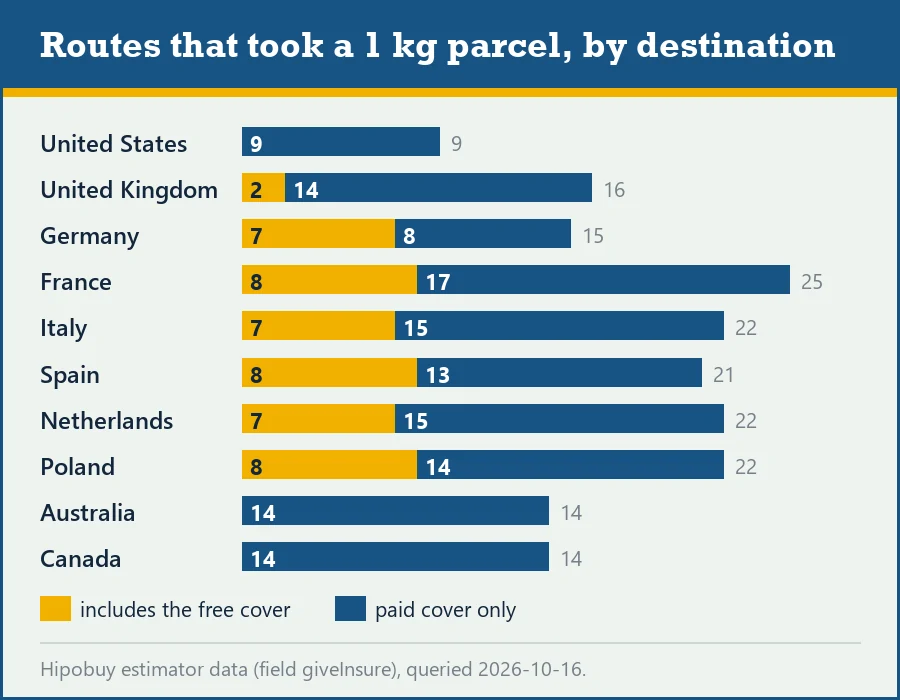
We queried the public estimator for ten destinations with a one-kilo box, 30 by 20 by 10 cm, and no product type selected. It returned 375 routes, of which 180 would take the parcel. 47 of those included free cover.
The split is stark. Not one route to the United States, Australia or Canada included free cover. In the six EU countries we tried, seven or eight routes each did, out of 15 to 25. The United Kingdom had 2 of 16.
Routes that do not take a one-kilo parcel of ordinary goods do not appear in these counts, so a heavier parcel or a different product type can change the list.
A route with free cover is not automatically the better buy. Price, delivery window and how the route bills weight still matter, and the free cover's value is the shipping plus 40 yuan a kilo, never the goods.
Paid options vary by route as well
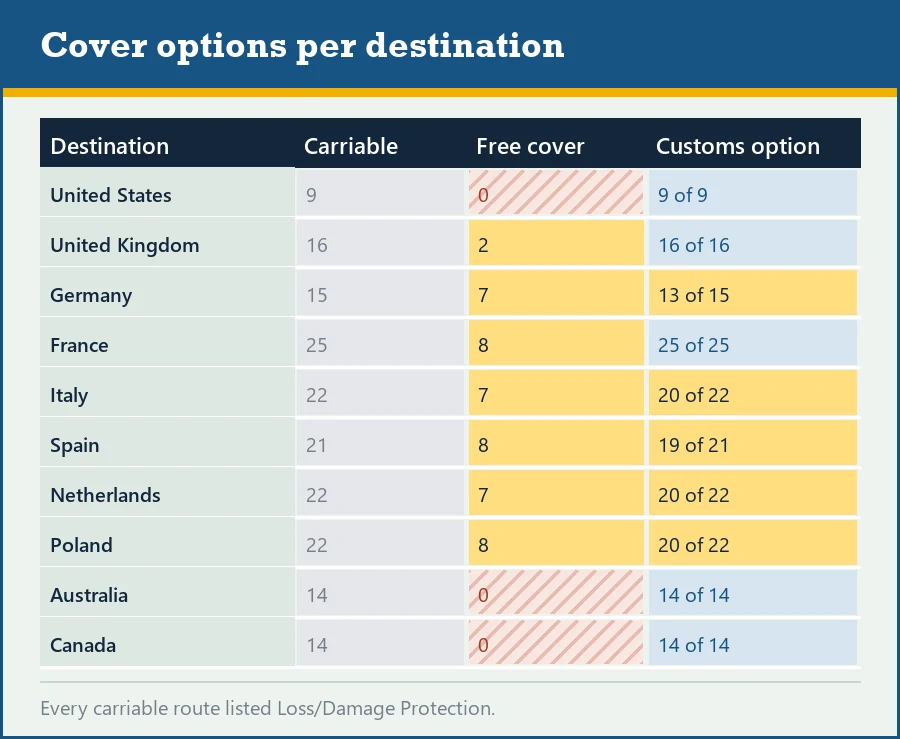
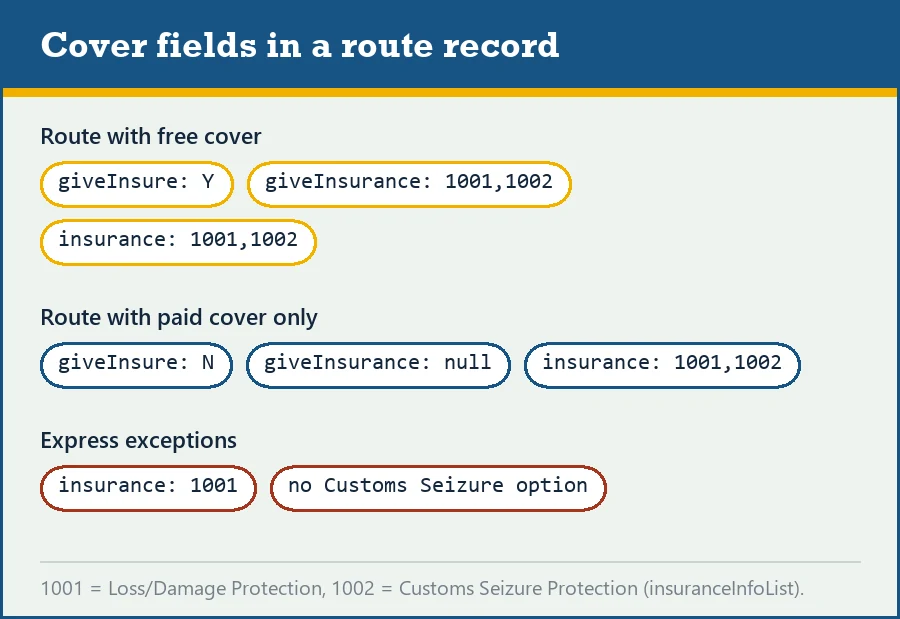
Every carriable route listed Loss/Damage Protection. Customs Seizure Protection was missing on 10 routes: two per country in Germany, Italy, Spain, the Netherlands and Poland, all of them express routes run with FedEx or Hong Kong UPS in their names.
If customs is your main worry, those routes leave you with only the free table, and none of them included free cover either. The comparator shows "Not offered" for customs on them.
A route that lists the customs option is not a guarantee of a goods-value payout for a seizure, since that option is worded three ways. For the United States, Australia and Canada the important column is the free one: with no free cover on any route we read, the customs line of the free table never applies there, and only the paid option has a published rule for a parcel held at the border.
Self-operated or settled-in: two claim standards and no labels
Hipobuy's Logistics Platformization Description divides routes into two kinds. On a self-operated route, it says, its own after-sales standard applies, "which is better than the logistics provider's compensation standard". On a settled-in route, run by a carrier that has joined the platform, Hipobuy applies to the carrier on your behalf and "the specific compensation amount depends on the compensation standards of the logistics provider".
Hipobuy does not say which routes are which. The estimator data carries a supplier number for each route but no supplier name, and route names are not a reliable guide, so we do not guess. Ask support, in writing, which kind your route is before relying on the tables.

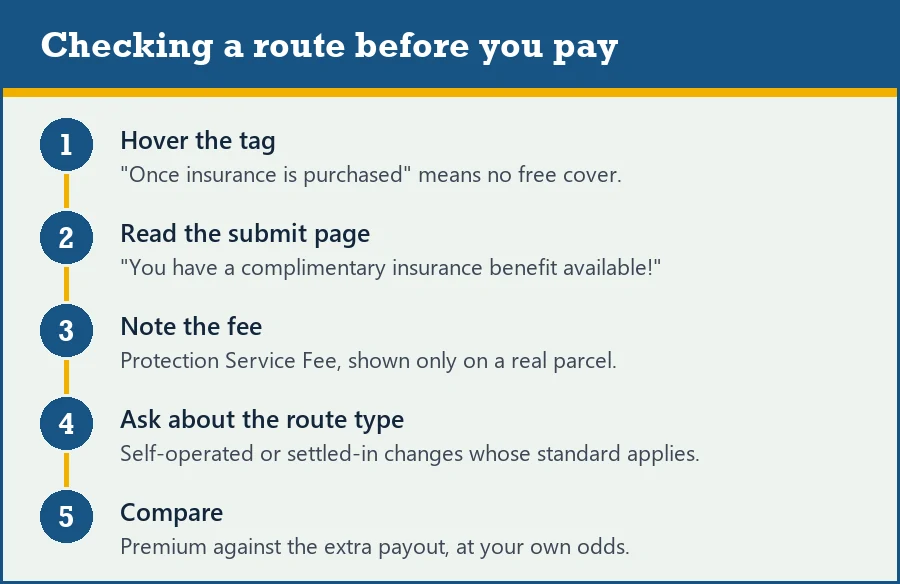
A thirty-second check before you submit
You can settle the cover question for a parcel in less time than it takes to choose packaging.
- On the estimator, hover the "Insurance" tag of the route you want. A box means paid cover only.
- On the submit page, look for the complimentary benefit message; it appears when the route includes free cover.
- Note the Protection Service Fee if you are considering paid cover.
- Ask support whether the route is self-operated, if the amount matters to you.
- Put the numbers into the comparator.
If the submit page and the estimator ever disagree about free cover, go by the submit page and keep a screenshot of both.
What the flag looks like in the estimator data
Behind each result card the estimator returns a record for the route. Four fields carry the cover information: giveInsure (Y or N, the free-cover flag), giveInsurance (which covers come free), insure and insurance (whether paid cover can be bought, and which options).
One oddity is worth knowing. On routes that include free cover, the description attached to the free cover in the data is a copy of the paid option's text, beginning "Loss/Damage Protection is a paid value-added service". The submit page's own tooltip for the free cover uses the free table's wording instead. We follow the table and the tooltip, and treat the copied description as a data slip.
None of these fields says whether a route is self-operated. The supplier number beside them is the nearest thing, and Hipobuy does not explain it, so it settles nothing.
Flags move when routes move
Routes are added, renamed and withdrawn all the time, and the free-cover flag goes with them. Our counts are a snapshot of one query on one day. A heavier parcel, a parcel with batteries or liquids, or a different week can produce a different list.
We rerun the same query when we update this guide and record the date on the notices and changes page. If you see a route where the hover test and the submit page disagree, write to us; that would be worth knowing.
To reproduce the counts, enter the same parcel on the estimator page and hover each Insurance tag. The numbers should match unless routes have changed since.