Payout comparator: free cover, paid cover and the premium that breaks even
Enter your parcel, pick what went wrong, and type the fee the submit page quoted. The comparator shows both payouts side by side and the chance of loss at which paying for cover starts to make sense.
Compare the payouts for your parcel
All amounts are in yuan (CNY), because Hipobuy's caps and per-kilo figure are set in yuan and payouts arrive as Hipo Coins worth one yuan each. If your account shows another currency, convert the shipping and goods figures from your order details first.
Using the comparator step by step
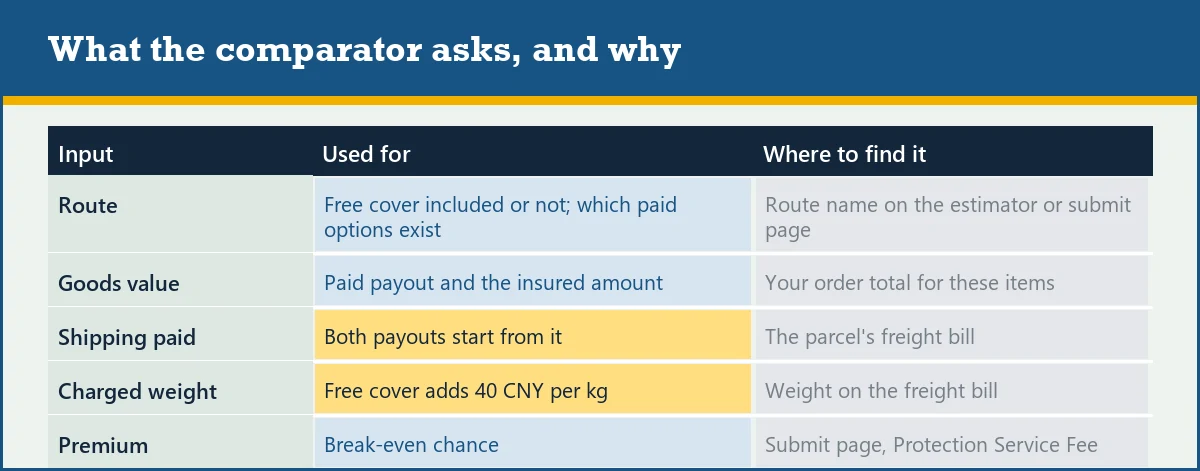
- Route. Pick the destination and route. The flags under the menu show whether the route includes free cover and whether Customs Seizure Protection is offered on it. If your route is missing, choose "My route is not in the list" and the free column is shown as if it were included.
- Parcel. Type the goods value, the shipping you paid and the charged weight in kilos.
- Event. Choose what went wrong. For a partial loss or partial damage, add the value of the affected items.
- Route type. Leave it on "not stated" unless support has told you whether the route is self-operated.
- Decision. Type the premium the submit page shows, and if you like, your own estimate of the chance of this event.
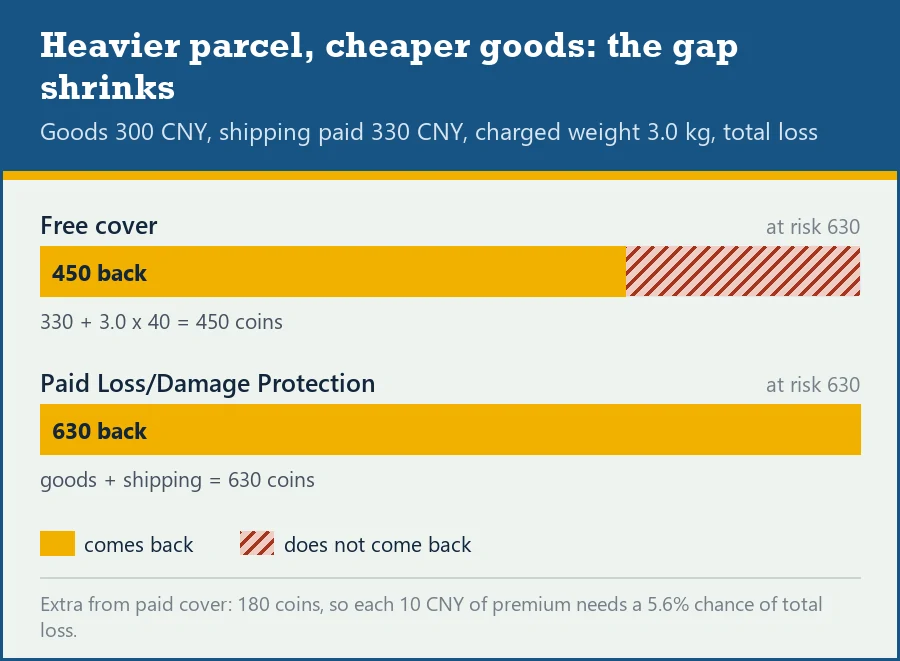
Compared with the lighter example, the free cover returns 71% of the loss here instead of 19%, so the premium has far less to buy. A premium that looks cheap for the light parcel can look expensive for this one.
Reading the two columns and the dark panel
The left column is the free cover, or "Not included" when the estimator data shows the route has none. The right column is the paid option that matches the event: Loss/Damage Protection for loss and damage, Customs Seizure Protection for customs.
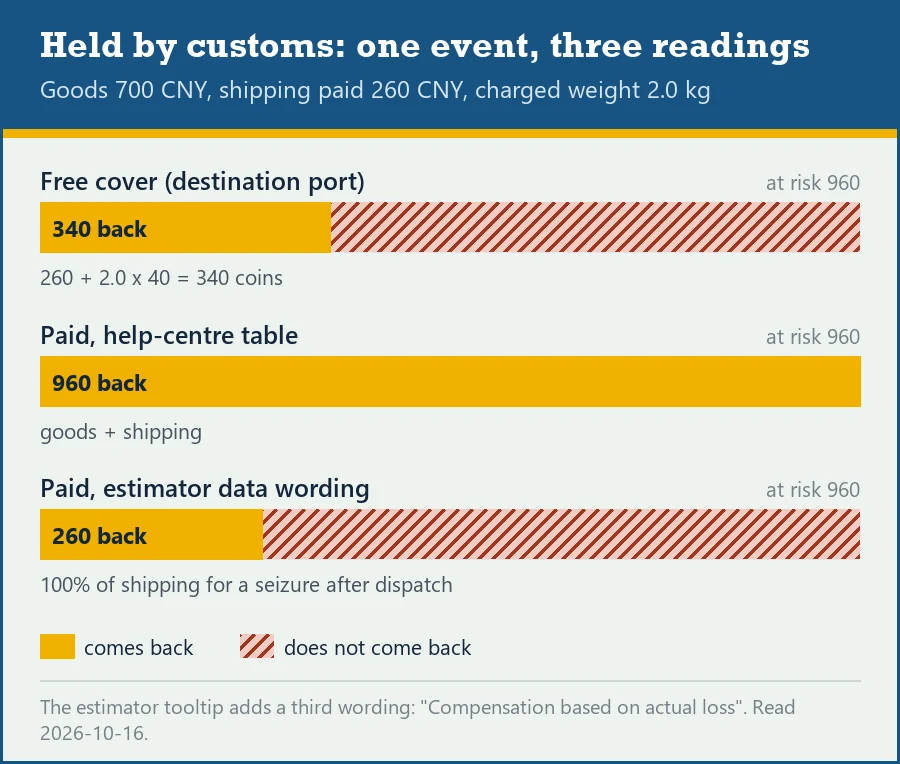
For customs the paid column shows a range, because Hipobuy describes that option three ways. Its help-centre table pays the goods plus shipping; the estimator data pays only the shipping for a seizure after dispatch; the estimator tooltip says "actual loss". The low end can be smaller than the free cover, and since the two cannot be combined, switching would cost you.
The dark panel turns the difference into one number: the chance of this event at which your premium pays for itself. It never says "buy" or "skip".
If customs is the risk you worry about most, ask support in writing which wording applies to your route before you pay. A written answer is also useful evidence if the claim is disputed later.
Three runs worth trying before your own
Before entering your own parcel, try these three. They show how differently the same rules land depending on weight, value and what went wrong. All inputs are ours.
| Run | Inputs | Free cover | Paid cover | Break-even per 10 CNY |
|---|---|---|---|---|
| Light and mid-price, lost | Goods 900, shipping 160, 1 kg | 200 | 1,060 | 1.2% |
| Heavy and cheap, lost | Goods 300, shipping 330, 3 kg | 450 | 630 | 5.6% |
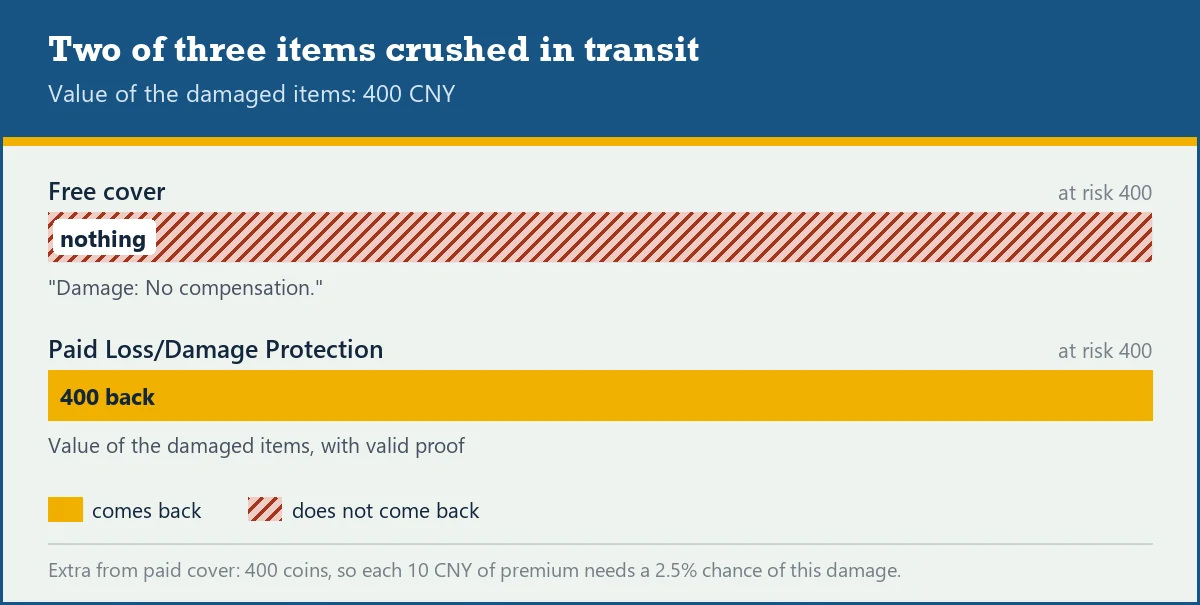
| Two of three items crushed | Goods 600, shipping 210, 1.5 kg, damaged 400 | 0 | 400 | 2.5% |
The damage run is the one that surprises people: the free cover returns nothing at all, so the whole paid payout counts as extra. If what you ship is fragile, that run, not the loss run, is the one to judge the premium by.
What the comparator deliberately leaves out
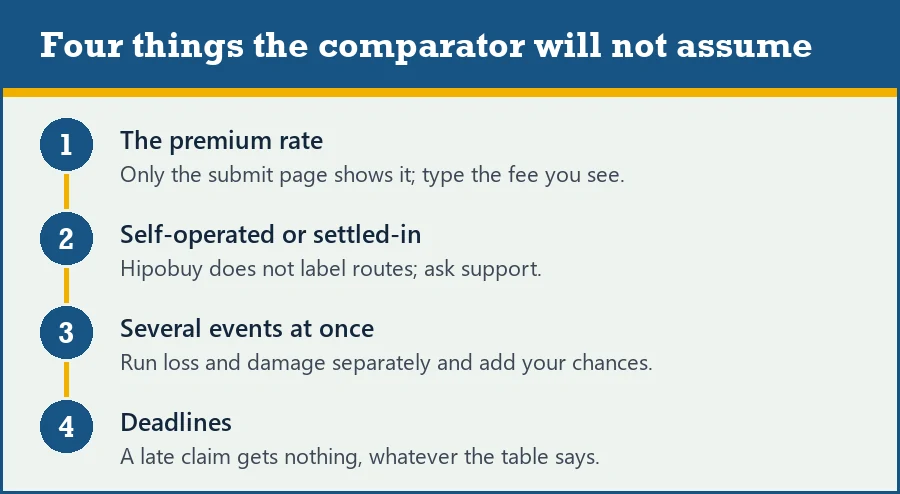
It does not know the premium rate, because Hipobuy only shows the fee on the submit page. It does not know whether your route is self-operated or settled-in, because Hipobuy does not label them; on a settled-in route Hipobuy says the amount follows the carrier's own standard, so treat the figures as Hipobuy's tables, not as a promise.
It also compares one event at a time. Paid Loss/Damage Protection covers loss and damage together, so if you want a full picture, run both events and add up the chances you assign to each. And it leaves out time: claims have deadlines, which the claims page sums up in one line.