Paid cover: the value of the goods, priced on the submit page
The paid options are the only Hipobuy cover that returns what the goods cost. They also replace the free cover rather than adding to it, and their price is something you only see when the parcel is ready to go.
Two paid options, chosen per parcel
Hipobuy sells two paid options, Loss/Damage Protection plus a separate Customs Seizure Protection, and every route record in the estimator data says which of them it offers. On 16 October 2026 every one of the 180 routes we read listed Loss/Damage Protection; 10 of them, the FedEx and Hong Kong UPS routes to Germany, Italy, Spain, the Netherlands and Poland, did not list Customs Seizure Protection.
Both share the free cover's ceiling: never more than what Hipobuy calls the insured amount (goods price plus freight), and never more than 5,000 yuan per claim. Payouts, by default, are credited as gold coins.
Each option is priced on its own on the submit page, so where both are offered you can take one without the other.
The rate appears on the submit page and nowhere else
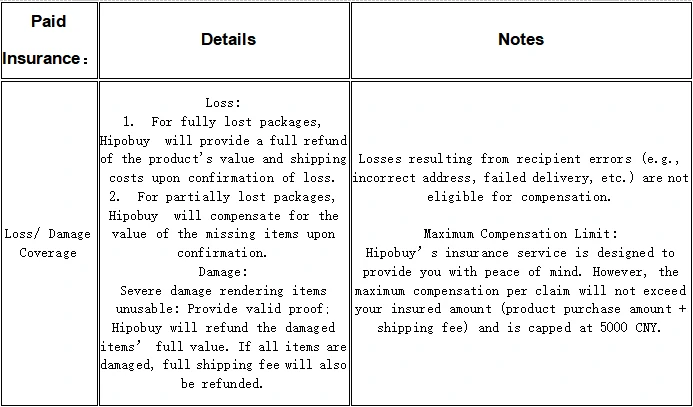
Hipobuy's public pages give the payout rules but not the price. The site's code names the fields that appear when you submit a parcel: "Choose Protection Service", "Free Protection Service", "Paid Protection Service", "Protection Rate", "Product Protection Amount", "Transport Protection Amount" and "Protection Service Fee". The rate and fee are filled in only then.
We could not see a rate without an account and a real parcel, so this site prints none. Old tutorial images occasionally show a percentage; we do not repeat it, because a screenshot of one parcel on one date is not a rate. The comparator takes the fee you see instead.
When you do see the fee, note what it was charged on. The field names point to a rate applied to a product amount and a transport amount, which would match the insured amount in the cap, but Hipobuy does not spell out the formula. If the fee looks out of proportion to the goods, ask before paying.
Loss/Damage Protection: the goods back, within the insured amount
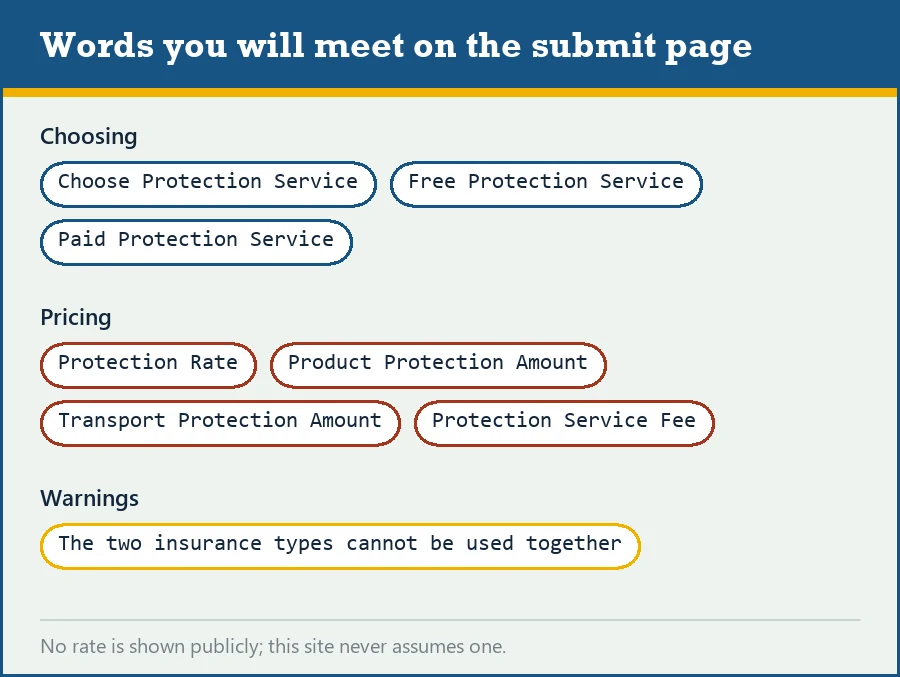
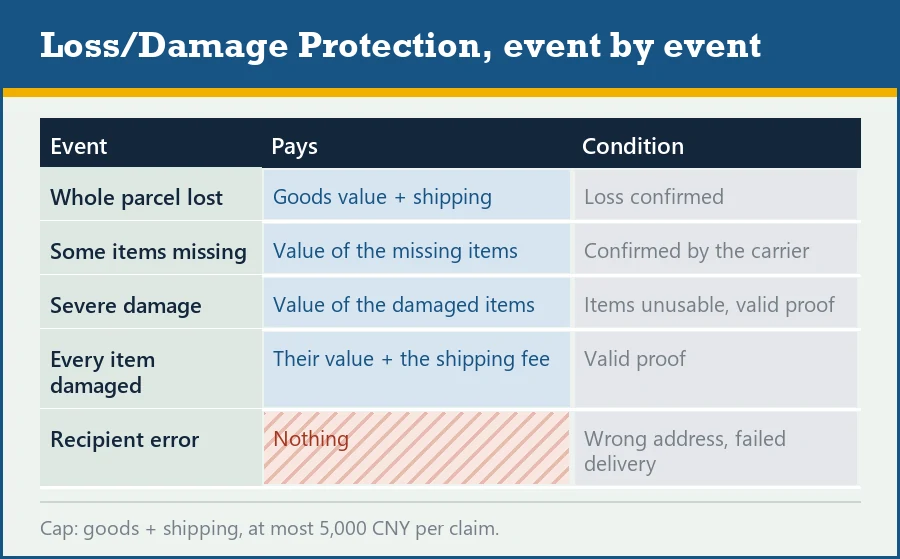
For a parcel lost in full, the table promises "a full refund of the product's value and shipping costs upon confirmation of loss". For a partial loss, the value of the missing items. If damage leaves items unusable and you can prove it, the full value of those items, and if every item in the box is damaged, the freight on top.
The estimator tooltip adds a condition worth noticing: "If confirmed by the logistics provider". In other words, the carrier's confirmation of loss or damage is part of the claim. The same recipient-error exclusion applies as on the free table: wrong address, failed delivery and the like are not paid.
Keep the warehouse photos and the carrier's tracking pages; a confirmation from the carrier is built on them.
Customs Seizure Protection, worded three different ways
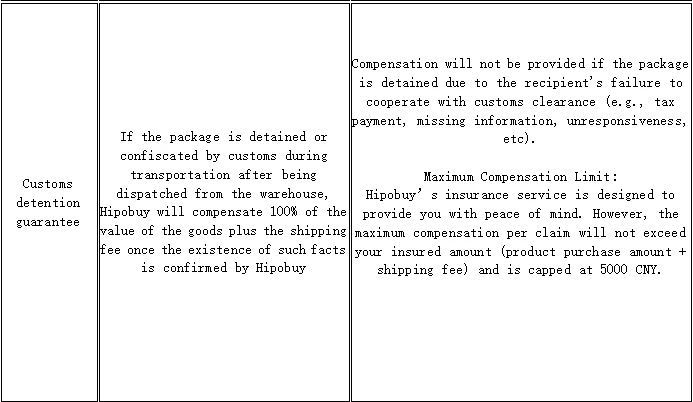
Here the official texts genuinely disagree. The paid table image, dated 9 January 2026, says a parcel seized or held by customs once it is on its way earns "100% of the value of the goods plus the shipping fee".
The description attached to the same option in the estimator data splits it in two: a seizure after dispatch is compensated at "100% of the actual shipping cost"; goods and shipping are paid only if clearance fails for another reason, such as destruction or confiscation after 90 days, and valid clearance documents are supplied.
The tooltip on the estimator page offers a third version: "Compensation based on actual loss, capped at the combined insured amount of product + shipping." We do not pick a winner. The comparator shows the range.
Buying paid cover means giving up the free one
On a route that includes free cover, the submit page greets you with "You have a complimentary insurance benefit available!" and explains that you can use it, or "forgo it and purchase more comprehensive paid insurance". The next line is a warning: "The two insurance types cannot be used together."
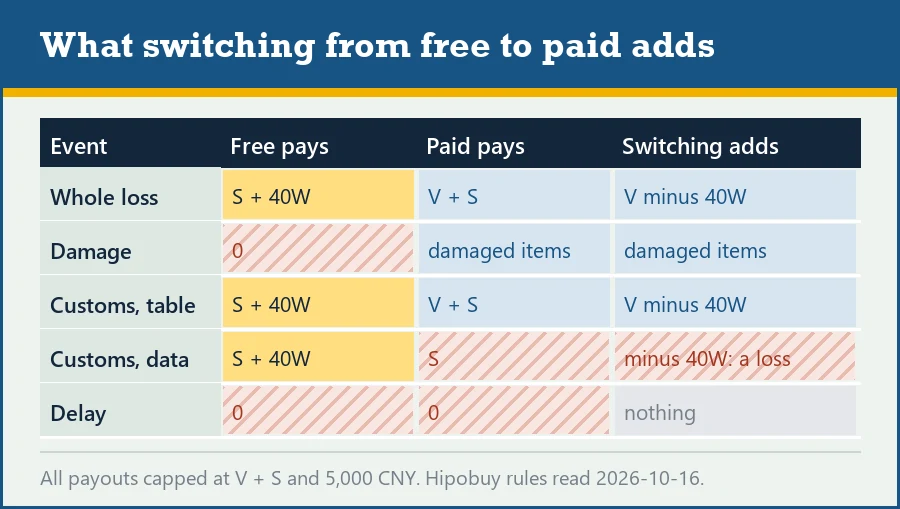
So the real gain from paid cover is not the paid payout, but the paid payout minus the free one you give up. For a lost parcel that is the goods value minus 40 yuan a kilo. For damage it is the full value of the damaged items, since free cover pays nothing. For customs it depends on the wording: under the estimator data's version, switching returns less than you had.
On routes with no free cover, paid cover is the only Hipobuy cover
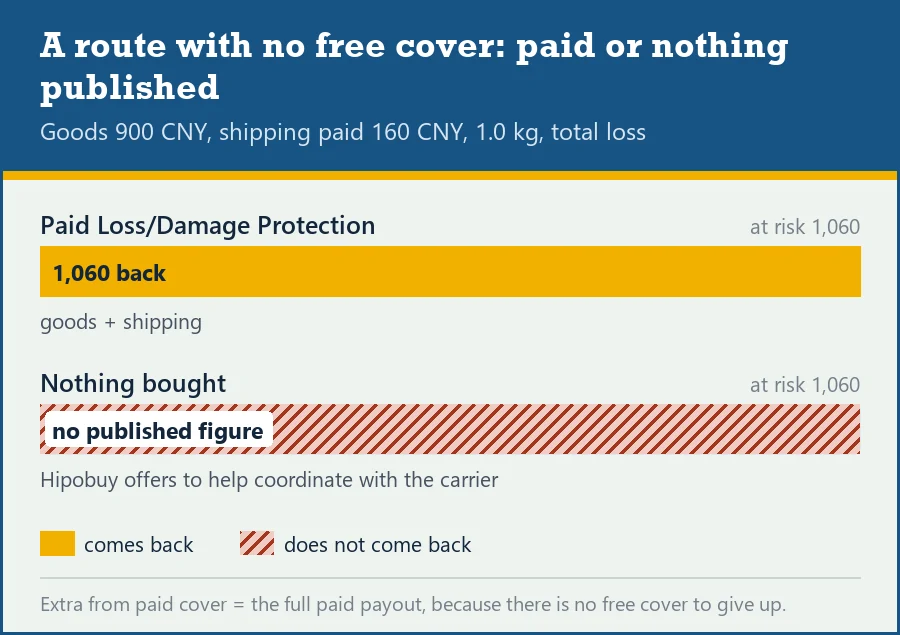
Every route we read to the United States, Australia and Canada lacked free cover, and so did most routes to the United Kingdom and about two-thirds of those to the EU countries we tried. On those routes the choice is not free against paid; it is paid against nothing Hipobuy has put a number on.
That makes the arithmetic simpler and the stakes higher. The extra payout from paid cover is the whole paid payout, because there is no free payout to give up. For the home-page example parcel on such a route, a total loss would return 1,060 coins with paid cover and no published figure without it.
Hipobuy's delivery disclaimer says that if a parcel is lost it "will assist in coordinating compensation matters" with the carrier. That is a promise of help, not an amount.
Where the paid option adds the most
Paid cover earns its keep on light parcels full of expensive things, on any route without free cover, and on anything fragile, because damage is the one event the free cover ignores entirely.
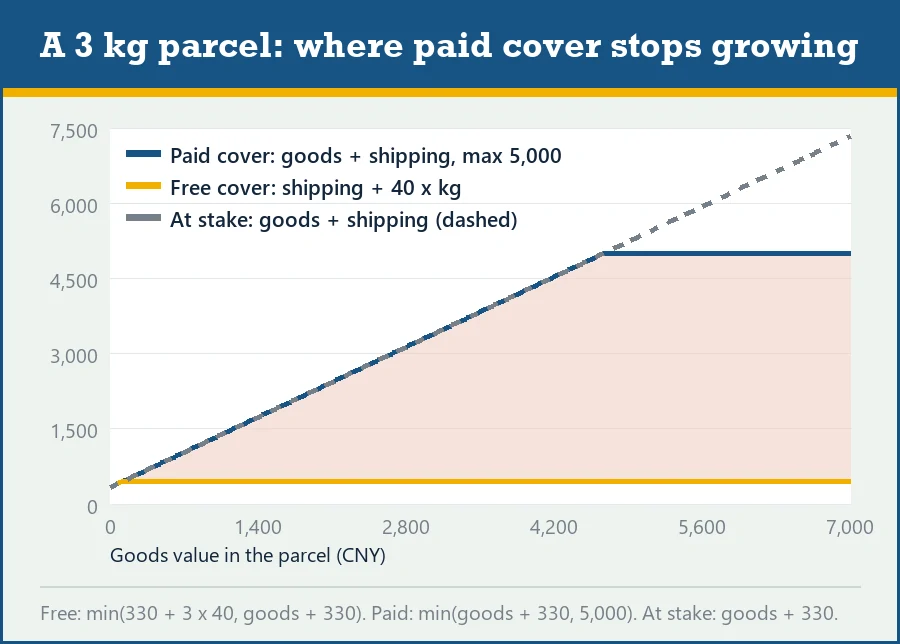
It earns least on heavy, cheap parcels, where 40 yuan a kilo already returns a large share, and it stops growing at 5,000 yuan. A parcel with more than 5,000 yuan of goods and shipping in it is only partly covered even with paid cover; splitting it into smaller parcels is the only way Hipobuy's own rules allow more, and each extra parcel brings its own shipping and declaration fee.
On the chart, the space between the gold line and the dashed one is what the free cover leaves out. The space between the navy line and the dashed one opens only beyond 5,000 yuan, and is what paid cover leaves out. For most parcels the second gap never appears.